

by Greyson Geiler
Accumulating wealth involves a combination of strategies that focus on increasing assets and investments over time. For different people, the end objective can be drastically different. A pension fund manager is going to have a completely different perspective than a young family who paid off bad debts and are now investing for their future. Everyone wants – all other things being equal – to have more money. However, there are many variables considering investor objectives that can affect investment strategy including risk tolerance, time frame for achieving objectives, liquidity needs among many other things. One variable that fits into nearly every investor’s planning strategy is diversification. No one wants “all of their eggs in one basket” so investors of all stripes attempt to have different investments to reduce volatility of the portfolio as a whole. The old-school retirement planning strategy of the 60-40 bond to stock ratio had a pretty good run from 1980 to 2008. That obviously correlated with a window of time where interest rates were going down across the world. Now the situation is different as interest rates went significantly higher a few years ago and are now trending sideways.
As much as investing changes with computer technology and central bank currency creation at will some things stay the same. “All-in” is a strategy in no-limit hold ‘em poker than many people are entertained by but few view as a viable investment philosophy. As a matter of fact, some of the most famous investors in recent history have declared that a true diversification is “The Holy Grail” of investing. Recent aggressive selloffs in the US stock market – where the bond market DID NOT rally higher have left some investors wondering if the whole monetary system and corresponding asset correlation relationships are changing…
We have been advocates of diversifying – and especially a very uncorrelated diversification – using gold. The statistical analysis of the relationship between gold and stocks and bonds can get wildly complicated depending on the time frame. There is a positive correlation in almost all assets when you analyze on a long enough time frame – because the value of the dollar is designed to go down at 2% per year (2% is the Federal Reserve’s stated inflation target.) But if we are talking about numbers of years rather than numbers of decades, gold and stocks have virtually NO statistical correlation. That doesn’t mean that when stocks go up gold goes down – or vice versa – that would be a correlation, but a negative one. Interestingly, stocks and gold can go up, sideways or down independently of each other. Take a look at the many different periods that stocks (as represented by the S&P500) and gold have moved uncorrelated since gold became available for individual investors again in 1975…
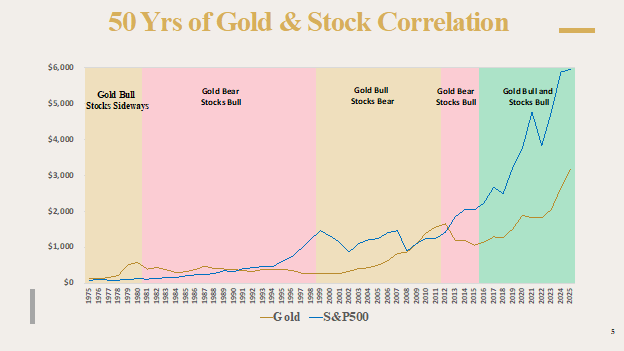
Color-coded time periods are shown in this chart starting with 1975 to 1980 when there was a bull-market in gold and stocks traded sideways. Then gold went red and was in a bear market from 1981 to 1999 while stocks were in a bull market. 2000 to 2011 was another bull market for gold – but this time it was a bear market for stocks. Next, we had another bear market for gold and a bull market for stocks. Finally, since 2015 we have had a bull market in both gold and stocks. You can see that until the recent joint bull market in these assets over the last decade – there is no correlation between them.
Looking at total portfolio management, the above comparison shows a true diversification which has been called the Holy Grail of Investing. Fund managers, retirees and every investor in between want to have assets in their portfolio that move independently of each other. In a stock bear-market a non-correlating asset may trade sideways or even rally providing a psychological advantage – maybe an asset to sell if liquidity were necessary. All assets going one direction in a portfolio is only nice when everything is going up!
Between stocks, bonds, real estate, gold, private equity, crypto, and many other assets the world of investing is getting ever more complicated. As much as things have changed, some things stay the same. Gold has represented value for thousands of years but some investors in recent decades in the west haven’t seen it as part of a modern portfolio. That is all changing now as gold is being recognized as such a non-correlating asset AND we can now get an interest yield while still owning the physical asset. Gold is coming back into the monetary system of the world as a capital asset! There is an interest rate on gold!! Our GoldRush Yield Fund has been built to participate in this rapidly expanding marketplace – reach our to us to learn more!
Regards and good investing,
Greyson Geiler
Market and industry data used in this presentation have been obtained from sources believed to be reliable. However, we have not independently verified such data and make no representation or warranty as to its accuracy or completeness.
Goldrush Yield Fund, LLC is managed by Andorra Capital, LLC, a Registered Investment Advisor. Andorra Capital has a conflict of interest in recommending the Fund to prospective investors. This material is informational only and does not constitute an offer to sell or a solicitation of an offer to buy any securities. The Goldrush Yield Fund is an unregistered private placement and is available solely to accredited investors. No securities commission or regulatory authority has approved or disapproved of the Fund, and there is no obligation to provide investment advice. Investing in the Fund involves risks, including the potential loss of principal. Past performance is not indicative of future results. Any forward-looking statements are based on current assumptions and are subject to change. Investors are responsible for conducting their own due diligence. Please review the Private Placement Memorandum (PPM) for detailed risk factors and consult with legal, tax, and investment professionals before considering any investment. For more information, please contact Greyson Geiler at ggeiler@andocap.com