Bonds Get Bombed

Bonds Get Bombed

The selloff in the world’s bond markets and the corresponding rise in interest rates continued this week especially in Euroland. The reasons for that are many including inflation fears and the Federal Reserve pulling back on their asset purchases which were $120 billion per month. Icing on the cake is the Fed claiming they will continue raising rates throughout the year; however some argue that that is supportive to LONG TERM bonds because it represents the Fed fighting against inflation which is the biggest danger to long term fixed income assets.

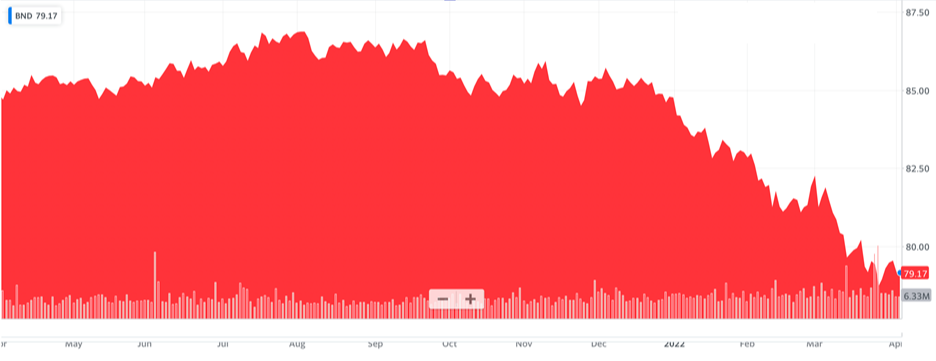
Of course, the economic world is reeling from supply shocks carrying over from the Covid “pandemic” and now the Ukraine situation. The biggest input in the inflation fears right now is the end user cost of gasoline. That is obviously just a headline issue with many problems behind the scenes – and the end result is a precipitous selloff in bonds of all different varieties. Our impression of the situation as usual, is that the Federal Reserve is largely at fault because of their actions inflating a ginormous world-wide bond bubble. Now the bonds are selling off leading financial observers to fear a popping of this bubble which would force the Fed to come in with more “stimulus” to prop the markets up. Take a look at a chart of the Vanguard total bond fund…

This has been an aggressive selloff in bonds in general, but what about the junk bonds? High yield corporate bonds or junk bonds are the debt with the most risk and therefore pay the highest interest rates. These bonds are what typically indicate stress in the credit system that may cause problems, even a purge of bad debt. For example, back in 2008 the interest rate difference between junk bonds and US Treasuries (no risk) was HUGE. It peaked at 21% – which means that junk bonds were viewed as so risky as the system was shocked by 2008 financial market chaos that they yielded 21% more interest than no-risk treasury bonds.

In March of 2020 at the depth of the Covid market fears, this spread pushed out to 11% – not panic like 2008, but a hefty interest rate difference. For perspective, now the spread between junk and treasuries is hovering near historic lows around 3%.  That isn’t telling us that a financial market Apocalypse is around the corner. As a matter of fact, it is an indicator that the markets are taking higher interest rates and the other economic dangers quite well. Of course, that is not an endorsement of the actions of the Fed – more a statement that it seems to us they are still getting away with their policies of way too loose money.

The stock market has stabilized, and commodity markets have calmed down. However, the Fed and many market observers are predicting as many as 10 more interest rate hikes before this credit tightening cycle is over. We will be looking for cracks in the dam all along the way because the idea that the Fed is going to raise rates until there is a soft landing in inflation, and everything goes back to “normal” seems WAY overly optimistic to us. So stay tuned, don’t get overly leveraged and don’t sell your gold!

Regards and good investing,

Greyson Geiler

The Fed is Raising Interest Rates

The Fed is Raising Interest Rates

Last week the Federal Reserve raised short-term interest rates .25%. This move was highly anticipated and many feel that if the fighting between Russia and Ukraine weren’t going on, the Fed would have raised rates .50% at this meeting. The Fed has indicated that they will continue to raise rates throughout the year – aiming for short-term rates in the 2% range.

Let’s take a quick walk back through history to when inflation numbers were last a serious concern. Back in the late 1970’s inflation numbers were raging, and the government was initiating wage and price controls to try to keep a lid on prices. Howard Ruff – a high profile economist at the time – was describing a “hyperinflationary spiral” that was going to turn the U.S. dollar into tissue paper. A doomsday prognostication of the value of the dollar was widespread. But then Paul Volcker came in as the chairman of the Federal Reserve and raised interest rates drastically. That brought on a recession, but it put an end to the inflation and gave birth to 40 years of asset price increases and a downtrend in interest rates. In September of 1981, the yield on the 10-year Treasury Note peaked at 15.32% – and then in June of 2020, the 10-year rate was just .62%.

Over this period of time, the median prices of houses sold in the U.S. rocketed from $64,900 to $411,200 – an increase of 533% !!! However, during this same period time, the U.S. median income only increased 254%, from $19,074 to $67,521 annually.  Essentially, the price of house increase doubled the pace of income increase. That was fueled by cheaper and cheaper credit supplied by the Fed and lower interest rates.  Also, cheaper and cheaper labor from Asia supplied the cover that would mask consumer price inflation over this period

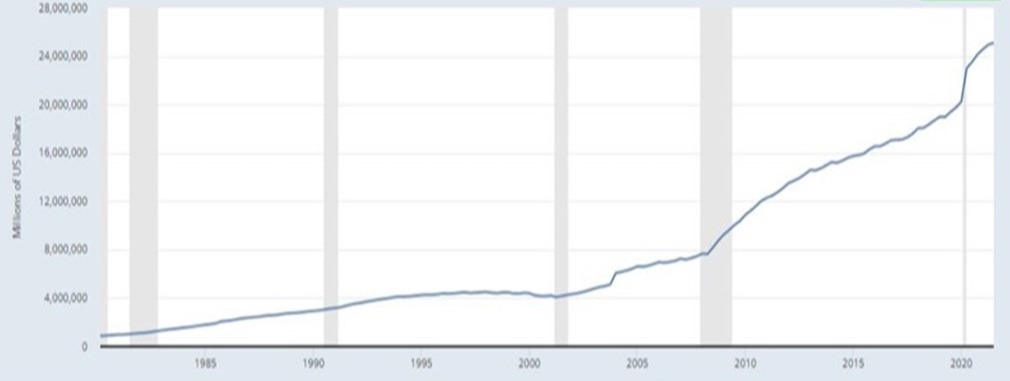
The situation is much different now from the perspective of the amount of debt in the system. Since the 1980s the world has aggregately accumulated a total of approximately $300 Trillion in debt (public, corporate and private.) Here is a chart of just US government debt since 1980…

This rocket launch of debt is obviously turbo-charged by continually lower interest rates. Over the last few years, we have even witnessed many trillions of $ of government debt worldwide with a NEGATIVE interest rate. Now with $300 trillion in aggregate world debt the FED is going to raise rates by 2% over the next year?  The world economy is roughly $90 Trillion annually and we are going to add $6 Trillion of debt service? Where will governments get the money to pay higher interest on their debts – especially government entities without a printing press – the state of Illinois, for example. Will the housing market hold together with significantly higher mortgage rates? What about corporate debt? Keep in mind that nearly 10% of American publicly traded companies are “zombies” according to our own Federal Reserve. This means that at current interest rates 10% of our companies can’t make enough money to pay their debt service – meaning they have to continue to borrow money and get further in debt to survive. Won’t higher interest rates tip that apple cart over?

The Federal Reserve is also removing the support of debt markets from the $120 Billion of monthly purchases. These debt markets (US Treasuries and mortgage-backed securities) haven’t even stabilized on their own yet – the Fed stated March would be the last month of purchases. We don’t even know what that stimulus removal alone will do to debt markets…

We are having a difficult time seeing the world economy holding together if interest rates continue higher. The 10-year treasury rate is pushing 2.5%. Of course, we don’t know where or when interest rates will push some of the bad debt in the system off a cliff, but we are confident that there will be SERIOUS hiccups in the system before we get to 2% on the overnight rate set by the Fed. We have a big week coming up of economic data and some market observers think the Fed may have to react more aggressively to these numbers and raise interest rates faster than previously suggested. We may see some more volatility in financial markets in short order – so stay tuned!

Regards and good investing!

Greyson Geiler

BIG Week Ahead

BIG Week Ahead

The financial market volatility is up and the liquidity (ability to trade in and out without moving the market price with your buy/sell) is correspondingly very low. Of course, much of this has to do with the Russia/Ukraine conflict, but there are lots of other market movers coming up this week. The Federal Reserve is meeting (and supposedly going to raise interest rates,) we have an inflation print coming that will probably top 10%, a retail sales number that will be terrible, possible Russian debt default, and crazy new Covid numbers raging across China. This week will be crazy. As Deutsche Bank’s Jim Reid summarizes what’s coming – it’s a big central bank week with the Fed the obvious focal point mid-week. The BoE and the BoJ also hold meetings, along with some of their emerging markets counterparts. We’ll also see CPI for Japan and Canada and a number of housing market statistics in the U.S. and China. Earnings will include Volkswagen, FedEx and Enel, among others.  – Wow – buckle your seat belt…

The Fed is expected to raise rates for the first time since December 2018 after its meeting concludes on Wednesday. Markets are pricing in a .25% hike in short term rates, in line with the rhetoric from Chair Powell at his congressional testimonies a couple of weeks ago. Many market observers were expecting .50% hike in the short-term rates before Russia invaded Ukraine – that is likely on hold at least for now. Fed Funds Futures pricing are still trading at levels indicating that the Fed will raise rates about 7 times (total of 1.75%) in this cycle. We will believe that 7 rate hikes will happen only when we see them…

Here are the highlights of the week courtesy of Deutsche Bank:

Monday March 14
Data: France trade balance
Other: Annual review of the “shopping basket” in the UK

Tuesday March 15
Data: U.S. PPI, China property investment, industrial production, fixed assets ex. rural, retail sales, Germany ZEW survey expectations, UK jobless claims change, ILO unemployment rate 3 months, Eurozone ZEW survey expectations, industrial production, Japan trade balance, Canada housing starts, manufacturing sales
Earnings: Volkswagen, RWE, Generali

Wednesday March 16
Data: U.S. retail sales, import price index, export price index, business inventories, NAHB Housing Market Index, China new home prices, Japan capacity utilization, core machine orders, Canada CPI, wholesale trade sales
Central banks: Fed decision
Earnings: Lennar, E.ON, Inditex
Other: NATO defense ministers meet

Thursday March 17
Data: U.S. housing starts, building permits, initial jobless claims, industrial production, capacity utilization, Japan CPI
Central banks: BoE meeting, ECB’s Lagarde, Lane, Schnabel, Visco speak
Earnings: Accenture, Enel, FedEx, Dollar General, Verbund

Friday March 18
Data: U.S. existing home sales, leading index, Italy trade balance, Eurozone trade balance, labor costs, Canada retail sales
Central Banks: BoJ meeting, Bank of Russia meeting
Earnings: Vonovia

Of course, all eyes are on the Fed this week, but we are very concerned about the inflation number and retail sales numbers as other indicators. We continue to monitor the markets to look for cracks in the dam indicating that more serious breakdowns of markets may be imminent. Obviously, things can change in a moment when war is on the horizon, but we do find it interesting that in such a potentially crazy week in the markets, this morning is showing a huge pull back in two of the panic indicators – crude oil and gold. Take a look…

Of course, all bets are off if war escalates, and we are not suggesting that you run out and sell your gold. But it is curious that in such a potentially crazy week some of the panic indicators are pulling back so hard. We are not suggesting that deflation is around the corner, but we are suggesting that the Fed won’t have to raise rates as much as many are expecting to calm inflation down. The Fed is probably shooting for a place where short term rates are 2-2.5% and the ten year rate is around 3% in order to “Goldilocks” us out of inflation fears and reel in some of the misallocated resources from the pandemic period. We think pullbacks in asset prices and other excesses will do much of that work before the Fed gets to those interest rates. Time will tell…

Regards and good investing!

News from Ukraine

Simply keeping track of all the market – moving news from the Ukrainian conflict can be a full-time job. Here is a snapshot of all the latest market-moving news out of Ukraine over the weekend and overnight, courtesy of Newsquawk:

Energy/Economic Updates:

U.S. Secretary of State Blinken said the U.S. and allies are in active discussions regarding a Russian oil import ban and reports later stated the U.S. is weighing acting without allies on a ban of Russian oil imports, although the timing and scope of any ban is still fluid, according to Bloomberg.

U.S. House Speaker Pelosi said the House is exploring legislation to ban the import of Russian oil.

Japan is in talks with the U.S. and Europe regarding a Russian oil embargo, according to Kyodo.

Russian Kremlin spokesman Peskov said there will be a reaction to the economic banditry they are seeing and that a ban on Russian oil risks the most serious market impact, while Peskov added that NATO is aware it cannot get directly involved in Ukraine. Kremlin also stated that companies will return to Russia and invest one day.

Russia said it is to service and pay Russian bonds fully on time but stated that payments on debts to foreign residents will depend on limits imposed by foreign states.

American Express (AXP) suspends operations in Russia and Belarus which is due to the Russian attack on the people of Ukraine. Visa (V) and Mastercard (MA) are also to suspend operations in Russia in which Visa noted that all transactions initiated with Visa cards issued in Russia will no longer work outside the country and Mastercard said cards issued by Russian banks will no longer be supported by its network. However, Russia’ s largest lender Sberbank noted that the Visa and Mastercards it issued will continue to work in Russia, according to Tass.

Banks in Russia are rapidly trying to move to the Chinese UnionPay’s system and its own Mir network after Visa and Mastercard suspended operations in Russia

VTB Bank is preparing to pull out of Europe, according to FT.

PwC is to separate its Russian firm from the rest of its global network which affects 3,700 partners and staff in the country.

TikTok limited services in Russia due to the ‘Fake News’ law and Netflix (NFLX) also decided to suspend its service in Russia.

Moody’s downgraded Russia’s sovereign ratings from B3 to CA; Outlook Negative, while it cut Ukraine’s sovereign rating two notches from B3 to Caa2.

Ukraine introduced export licenses for key agricultural commodities including wheat, corn and sunflower oil.

Discussions/Negotiations:

Russia will stop invasion if Ukraine agrees to the following demand: constitutional amendment ruling out membership of any blocs (NATO); Ukraine must recognize Crimea as Russian, and Donetsk and Lugansk as independent states.

Russia-Ukraine discussions to commence at 12:00GMT/07:00EST on Monday, according to Russian State TV citing Belta; Russian delegation has arrived for the discussions; subsequently, Ukraine Presidential Adviser says new talks with Russia will start at 14:00GMT/09:00EST.

Russian & Ukraine Foreign Ministers are to meet in Antalya, Turkey, according to the Turkish Foreign Minister; meeting will occur on Thursday.

Ukrainian Foreign Minister Kuleba said he doesn’t see progress in peace talks with Russia but have to continue talking, while he talked to U.S. Secretary of State Blinken about providing more weapons to Ukrainian fighters and implementing more sanctions against Russia. Furthermore, U.S. Secretary of State Blinken said unprecedented pressure on Russia will increase until the war with Ukraine is brought to an end, according to Reuters.

Russian President Putin warned that they would consider any third-party declaration of a no-fly zone over Ukraine as participation in the armed conflict and said western sanctions are akin to a declaration of war, while he added there is no reason to declare martial law in Russia.

Russian President Putin held a call with Turkish President Erdogan in which Putin said Russia is ready for dialogue with Ukraine and foreign partners, while he added that the military operation in Ukraine is going according to plan and any attempt to draw out the negotiation process will fail.

Russian President Putin and French President Macron held a call on Sunday in which Putin told Macron that he agreed to talks between the IAEA, Ukraine and Russia to ensure security at nuclear sites.

Russian Defence Ministry said the use of airfields of other countries by Ukraine airforce may be considered as participation of those countries in the conflict, according to Interfax.

Russian Foreign Ministry said Britain has chosen to move towards open confrontation with Russia and that Russia will respond which will undoubtedly undermine British interests in Russia.

Third Party remarks:

UK Deputy PM Raab said sanctions are not a war crime and that talk of Russia using nuclear weapons is rhetoric and brinkmanship, while he added that China and India have to step up.

UK parliament is to vote on sanction measures after the government put forward a series of amendments to the economic crime bill to crack down on corrupt elites and further ramp up pressure on Russian President Putin’s regime, according to Reuters

UK Chief of Defense Staff Admiral Radakin said Russian lead forces have been decimated and it is not inevitable that it will succeed in taking over Ukraine, according to the Times.

New Zealand announced sanctions on Russian oligarchs and published a travel ban list of 100 people. PM Ardern said they will stop superyachts, ships and aircraft from entering New Zealand territory, while sanctions will prevent Russian people and companies from moving money and assets to New Zealand to avoid other sanctions.

Russian ambassador to the IAEA says Russia is favorable to the suggestion from IAEA Chief Grossi of a three-way meeting on Ukraine.

Defense/Military Response:

Ukrainian President Zelensky said Russian forces are preparing to bombard Odessa city and that it will be a war crime; subsequently, Ukrainian staff suggest that Russian ships have struck Ukrainian troops’ position in the Odessa region, according to Al Jazeera News.

Russian military is to hold fire and open humanitarian corridors in several Ukrainian cities at 10:00 local time (07:00GMT/02:00EST) on Monday, while corridors from Kyiv, Mariupol, Kharkiv and Sumy will be opened at French President Macron’s request, according to IFAX.

Subsequently, the Ukraine Deputy PM says humanitarian corridors are still yet to open and they rejected the proposed corridors to Belarus.

Russian Ministry of Defense said the Security Service of Ukraine and Azov neo-Nazi militants are preparing a provocation with possible radioactive contamination of the area near the city of Kharkiv, according to Sputnik.

IAEA said it was informed by Ukraine that the Zaporizhzhya nuclear plant management is under orders from the commander of Russian forces that took control of the site last week, while it stated that some mobile networks and internet was switched off by Russian forces at the site so that reliable information cannot be obtained through the normal channels.

U.S. is talking to Poland about a deal to send Soviet-era aircraft to Ukraine in return for American F16 jets.

U.S. officials said Russia is recruiting Syrians for urban combat in Ukraine, according to WSJ.

UK PM Johnson spoke with Ukrainian President Zelensky and told him he would work with partners to provide further defensive equipment.

Other:

IAEA and Iran issued a joint statement regarding resolving outstanding questions raised by the IAEA regarding three nuclear sites in which Iran will provide written explanations including related supporting documents to questions raised by IAEA that have not been addressed by Iran on the three locations by March 20th. IAEA will then submit any questions regarding the information provided by Iran within two weeks after that and the sides will then meet within a week in Tehran following the IAEA’s submission of any questions on such information.

IAEA chief Grossi said the exchange with Iran was very fruitful and noted that they have several important matters they need to resolve together, while he added that it would be very difficult to imagine the 2015 nuclear deal would be revived if safeguard issues are not resolved. Furthermore, Iran’s nuclear chief said they are very optimistic about resolving nuclear issues with the IAEA and that the remaining issues will be resolved in 3-4 months.

Iran’s government said Russia’s new demands for guarantees from the U.S. are not constructive for nuclear deal talks after Russia recently placed new demands on the table for written guarantees from the US that sanctions on Moscow would not damage its cooperation with Iran.

North Korea fired at least one projectile into the East Sea that was suspected to be a ballistic missile, while North Korea later confirmed that it tested a recon satellite on Saturday.

IAEA Chief Grossi says, at N. Korea’s Yongbyon site, they are observing the construction of an annex to the reported enrichment facility, purpose of this yet to be determined.

With all this news coming out financial market participants are getting tossed around in chaos. We have our eyes on the safe-haven indicators of gold, crude oil and the treasury bonds. So far markets are holding together reasonably well considering the dangerous potential of the situation. Obviously, that could change at a moment’s notice so stay tuned…

Regards and good investing!

Markets React to Russian Aggression

Markets React to Russian Aggression

Last week was a really long short week as volatility took off after the President’s Day holiday. Obviously, the catalyst to the volatility was the military attack of Ukraine by the Russians with all sorts of wild speculation about the start of World War III.  The Chinese flexed their military muscle by flying in Taiwan airspace again which added to the image of chaos breaking out. Even “Little Rocket Man” Kim Jong-Un of North Korea got in on the game with another rocket launch into the sea near the Pyongyang international airport. The stock market recovered very well by the end of the week and some of the commodity panic moves in crude oil and gold eased off implying that the worst may be over.

But there are serious concerns going forward no matter how well asset markets recovered at the end of last week. The conflict in Ukraine certainly isn’t over as there are still reports of fighting and no one knows how this will turn out. There are many other factors that may affect the world’s economy and markets as well – the flow of energy all over Europe among the most important. The Western banking powers are in the process of taking Russian banks off the SWIFT system which would paralyze them from international transactions. Consequently, the financial markets in Russia are melting down. Here is a look at the Russian Ruble…

This is devastating short term for the Russian people. Many citizens back in Mother Russia are fearing for their livelihood as sanctions from the West have initiated panic including bank runs for cash. So clearly this acquisition by Russia isn’t going as smoothly as that of Crimea from 2014. This situation looks a little more like the situation in Georgia, where Russian military forces were removed after peace talks in 2008 but then continued to move the border of Russia further into Georgia.  But there was a worldwide economic challenge at that point and this time around things look much worse in Russia and there are at least some protests within the Russian Federation against this conflict.

Of course, this entire conflict is way more nuanced than simply Vladimir Putin is the boogeyman. Although there can be no mistake of the Russian attempt to expand its empire, the expansion of NATO from the West is considered aggression by the Russians. We do our best to avoid political discussions and keep our analysis economic – so as of the writing of this post, the Russians are in “peace talks” with leaders from Ukraine. Stay tuned…

As far as how all of this will affect our investing in the western world, the obvious question is what will the Federal Reserve do next? The financial markets have been assuming that the next action will be interest rate hikes. Some pundits have been talking about hikes as many as eight times this year. We were never in the camp that interest rates would go up that much and at this point we are wondering if the Fed will put rate hikes on pause until more order is restored. Keep in mind that since the Lehman Brothers’ scandal in 2008, central banks around the world have purchased $24 trillion in assets (corporate bonds, sovereign bonds, asset-backed securities, stocks, ETFs, etc.) and placed them on their unaudited balance sheets in the ether in the sky. Maintaining the valuation of these assets and the remainder of assets in the marketplace has become a self-imposed mandate of the Federal Reserve and other Central Banks around the world. We see them being much more cautious raising interest rates into an environment that has already taken the froth of the top of the “asset bubble.” Frankly, some of the growth stocks have sold off so aggressively because of potentially higher interest rates that some financial managers are already starting to bargain hunt.

Good news from the American perspective comes in from the treasury auctions of last week. Our treasury is still issuing trillions of dollars in debt and foreigners were here in droves last week to purchase those notes and bonds. The world is still clearly in the camp of maintaining the U.S. dollar as the world’s reserve currency! We are cautiously optimistic that the conflict in Ukraine will soon be in financial markets’ rear view mirror. But that does not mean rush out and sell your gold…

Regards and good investing!